
Job Application Automator: How to Automate Job Applications With AI (2026)
What a job application automator does, how to automate job applications with AI safely in 2026, which parts to automate, daily limits, and the setup that keeps callbacks high.
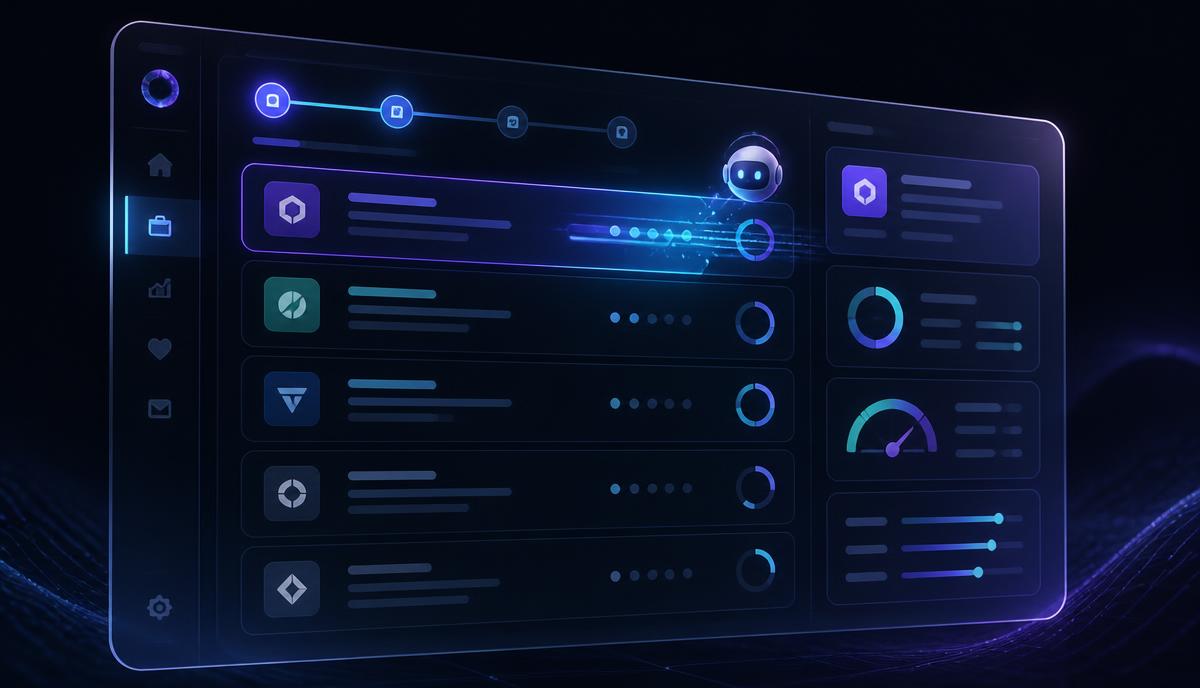
A job application automator is software that handles the repetitive parts of applying for jobs: pulling matching postings, scoring each one against your real experience, tailoring your resume and cover letter to the posting, filling standard screening fields, submitting, and logging the outcome. The safe way to automate job applications in 2026 is to automate discovery, scoring, tailoring, form-filling and tracking while keeping a human approval step — and to avoid browser scripts that drive a logged-in job board session, which breach platform terms. Tailored automated applications convert to first-round interviews at roughly 6-9%, versus 1-2% for untailored mass sends, so cap volume at 8-15 tailored applications per weekday rather than hundreds.
- A job application automator automates six steps: discovery, match scoring, tailoring, screening answers, submission and tracking.
- Automate the repetition, not the judgment — fit decisions and final approval should stay human.
- Hosted AI career agents are compliant; browser bots that drive your logged-in LinkedIn or Indeed session are not.
- Never hand any tool your job board password or session cookie.
- Quality beats volume: 8-15 tailored applications per weekday outperform 100 identical ones.
- Agent Auto Hire runs the full automated pipeline from $9/month, with one free AI resume optimization.
1. What a job application automator actually is
A job application automator is software that performs the repetitive mechanics of applying — discovery, fit scoring, per-job tailoring, screening-question answers, submission and tracking — while you keep the judgment calls. The category name is doing a lot of work, though, because two very different products call themselves the same thing: hosted AI career agents that generate and submit tailored applications, and browser scripts that puppet your logged-in job board session. Only one of those is safe to run.
The reason automation matters in 2026 is arithmetic. A properly tailored application — resume rewritten in the posting's language, cover letter grounded in the specific role, screening fields answered accurately — takes a careful person 20 to 35 minutes. Sustaining 12 of those a weekday is a 5-hour daily job on top of whatever else your life contains. Almost nobody sustains it for six weeks, which is roughly how long a search takes. Automation is what makes the correct strategy survivable.
2. The six steps worth automating
- Discovery. Deduplicated postings pulled from boards and company career pages against 2-4 exact titles, a seniority band, a salary floor, and a location or remote preference. This alone saves an hour a day of tab-checking.
- Match scoring. Every posting graded against your actual years, tools and domain, with the specific gaps named. This is the highest-value step, because the most useful thing automation does is tell you not to apply.
- Resume tailoring. Bullets rewritten in the posting's terminology, sections reordered toward what the requisition emphasizes, the three most relevant projects surfaced — using only facts already in your resume.
- Cover letters and screening answers. One grounded letter per role, plus stored factual answers for work authorization, notice period, salary expectation, relocation and years of experience.
- Submission. Filing through official application flows, with an approval queue for anything going to an employer you care about.
- Tracking. Company, title, date, match score, resume version and outcome — the dataset that tells you whether to change your targeting or your resume.
Skip step 2 and you get beautiful applications sent to jobs you were never going to get. Skip step 3 and you get a spam machine. Skip step 6 and you learn nothing across six weeks of effort.
3. Three types of automator — and the risky one
- Hosted AI career agents. Cloud services that discover, score, tailor and submit through official flows, with a review queue. Lowest risk, best conversion, subscription cost. This is the category Agent Auto Hire sits in.
- Assisted autofill tools. Extensions that populate application forms from a stored profile but leave you to click submit. Safe and mildly useful; they do nothing for tailoring or targeting, which is where callbacks are actually won or lost.
- Full browser bots. Scripts and extensions that drive your logged-in LinkedIn or Indeed session, clicking Easy Apply hundreds of times. These breach platform terms — LinkedIn's User Agreement explicitly prohibits automated access and scripted interaction — and detection patterns like superhuman submission speed lead to restriction or permanent bans. More detail in the LinkedIn Easy Apply bot guide.
The dividing line is simple: automating your own materials and submissions is fine; automating someone else's logged-in interface is not. Never give any tool your job board password or session cookie — that is the single most common way people lose the professional network they spent a decade building.
4. How to automate job applications in about an hour
- Fix the master resume first (20 min). Everything downstream inherits it. Single column, parseable sections, every bullet rewritten as action, method and quantified outcome. Get the ATS score above 85 before automating anything — see the 2026 ATS playbook.
- Define narrow filters (10 min). Two to four exact titles ("Senior Data Analyst", not "analyst"), a seniority band, a hard salary floor, and remote type. Narrow filters are what make high volume survivable.
- Set a match threshold (2 min). Around 75%. Below it, nothing gets sent. Honor the threshold even in a slow week; loosening it is how searches quietly turn into spam.
- Store your screening answers (10 min). Authorization, notice period, salary expectation, relocation, years with each core tool. Written once, reused hundreds of times.
- Turn on tailoring, not templating (5 min). Confirm the tool rewrites per posting and shows you an ATS preview before submission. A tool that attaches one static PDF is not an automator, it is a mailer.
- Set the approval rules (5 min). Auto-submit routine matches; require manual approval for your top 30% of companies and anything above your target comp band.
- Cap daily volume (1 min). 8-15 per weekday. Then audit the first five submissions line by line before you let it run unattended.
5. What must stay manual
Automation earns its keep on typing, not on thinking. Keep these human every single time:
- Which companies you actually want to work at, and which you would decline.
- Verification of every number, date and claim before submission — you own everything the tool writes.
- Applications to top-choice employers, which deserve a real read and often a manual paragraph.
- Referral requests and recruiter outreach, which still beat every automated channel on conversion.
- All interview conversation. Using AI live in an interview or a proctored assessment is disqualifying.
6. The volume math nobody does
Assume a 6-9% first-round interview rate on tailored applications and 1-2% on untailored ones. Twelve tailored applications a weekday for three weeks is 180 submissions and roughly 11-16 first rounds. Six hundred untailored submissions over the same period yields roughly 6-12 first rounds, from applications that damaged your standing at companies you may want later.
The trap is that untargeted volume feels productive. A counter that reads "412 applications sent" is emotionally satisfying and strategically empty. The metric that matters is interviews per 100 applications, and it moves almost entirely with fit and tailoring.
7. Is automating job applications allowed?
Yes, with two firm boundaries. Employers use automated screening on their side of the pipe, and no mainstream employer prohibits applicants from using software to prepare and submit their own materials. The boundaries are: never fabricate anything, and never automate a platform whose terms forbid it. If a posting explicitly says no AI-generated materials, follow the instruction.
Recruiters can usually tell when output is unedited — inflated adjectives, symmetrical sentence rhythm, buzzword stacks and bullets without numbers. They cannot tell when it is edited, because the content is your real experience in clearer language. Budget 90 seconds per application to cut the tells and restore your voice. See is it okay to use AI for job applications.
8. Eight mistakes that kill callbacks
- Automating on top of a weak master resume, which multiplies the weakness across 200 sends.
- Filters set to a broad keyword instead of exact titles, producing a feed you cannot act on.
- Dropping the match threshold when the feed goes quiet.
- Letting the tool attach one static resume to everything.
- Cover letters that name no product, team or specific problem.
- Screening answers that contradict the resume — a fast, silent rejection.
- Running an unattended bot against a logged-in job board session.
- Never reading the tracked outcomes, so the same failing phrasing runs for six weeks.
9. Measuring whether it works
Review weekly against four numbers: applications sent, first-round interviews per 100 applications, median match score of what was sent, and reply time. If the interview rate sits under 3%, the problem is targeting or the resume, not volume — narrow the titles and raise the threshold before you send more. If the match scores are high but replies are not, the tailoring is generic and the cover letters are probably interchangeable.
For the honest version of what automation can and cannot deliver, read our guide to AI Auto Apply and how AI job application bots work.
10. A 14-day automation plan
- Days 1-2. Rebuild the master resume, run an AI optimization, push the ATS score past 85.
- Days 3-4. Lock filters and the 75% threshold; store screening answers; audit the first five tailored drafts by hand.
- Days 5-9. Run 8-12 tailored applications per weekday with approval on top-choice employers. Log everything.
- Day 10. Review the four metrics. Adjust titles, threshold or resume — one variable at a time.
- Days 11-14. Continue at volume, add two referral or recruiter outreaches daily, and start interview prep from the requisitions that converted. See how AI tailors a resume to a job posting.
Agent Auto Hire runs this entire pipeline — discovery, match scoring, per-job resume and cover letter tailoring, screening answers, submission with an approval queue, and tracking — starting free with one AI resume optimization, and from $9/month for ongoing automated applying.
Frequently asked questions
What is a job application automator?+
A job application automator is a tool that performs the repetitive steps of applying for jobs on your behalf: finding postings that match your titles, seniority, salary floor and location, scoring each posting against your real experience, rewriting your resume and cover letter for that specific job, filling standard screening fields, submitting the application, and logging it so you can track replies. The good ones keep you in the loop with an approval queue; the bad ones just spray one static resume everywhere.
How do you automate job applications with AI?+
Upload one accurate master resume, define 2-4 exact target titles with a seniority band, salary floor and remote preference, set a minimum match score (around 75%) below which nothing is sent, let the AI tailor the resume and cover letter for each qualifying posting, store answers to standard screening questions once, keep manual approval on your top-choice employers, and review the tracked outcomes weekly to adjust titles and phrasing.
Is automating job applications allowed?+
Using AI to find, tailor, write and submit your own applications is allowed — employers screen with AI themselves and no mainstream employer bans applicants from using software to prepare materials. What is not allowed is automated access to platforms that prohibit it: LinkedIn's User Agreement forbids scripts and scraping, so browser bots that drive your logged-in session risk account restriction. Fabricating any fact is never acceptable, automated or not.
Can automated job applications get you interviews?+
Yes, when each submission is tailored. Applications rewritten against the specific posting convert to a first-round interview at roughly 6-9%; identical mass-sent applications convert at 1-2%. Automation is what makes tailoring affordable at volume — it is not a substitute for it.
How many jobs should an automator apply to per day?+
Eight to fifteen tailored applications per weekday. There simply are not 100 genuinely matching postings published daily for one title and level, so higher targets force you to loosen filters until you are applying to jobs you cannot get, which drives your conversion rate toward zero.
What parts of a job application should stay manual?+
Deciding which companies you actually want, verifying every number and claim before submission, anything sent to a top-choice employer, referral and recruiter outreach, and all interview conversation. Automate the typing, not the judgment.
Are browser extensions that auto-apply safe?+
They carry real risk. Extensions that drive your logged-in LinkedIn or Indeed session violate those platforms' terms, and detection patterns like superhuman submission speed can trigger restriction or a permanent ban. Any tool that requires your job board password or session cookie should be rejected outright — losing your professional network costs more than the applications gained.
How much does job application automation cost?+
Free tiers generally cover a resume optimization and limited matching; paid career agents typically run $9-$49 per month depending on application volume and features. Agent Auto Hire starts free with one AI resume optimization, with paid plans at $9, $29 and $49 per month for higher auto-apply volume and advanced tailoring.
We build the AI career agent behind Agent Auto Hire — resume optimization, ATS scoring, job matching, and review-before-submit Auto Apply. Everything here comes from data across real applications processed on the platform, not theory.
Let Agent Auto Hire do this for you
Upload your resume and get an AI-optimized version free. Then let our AI agent match jobs and auto-apply for you.
Start free